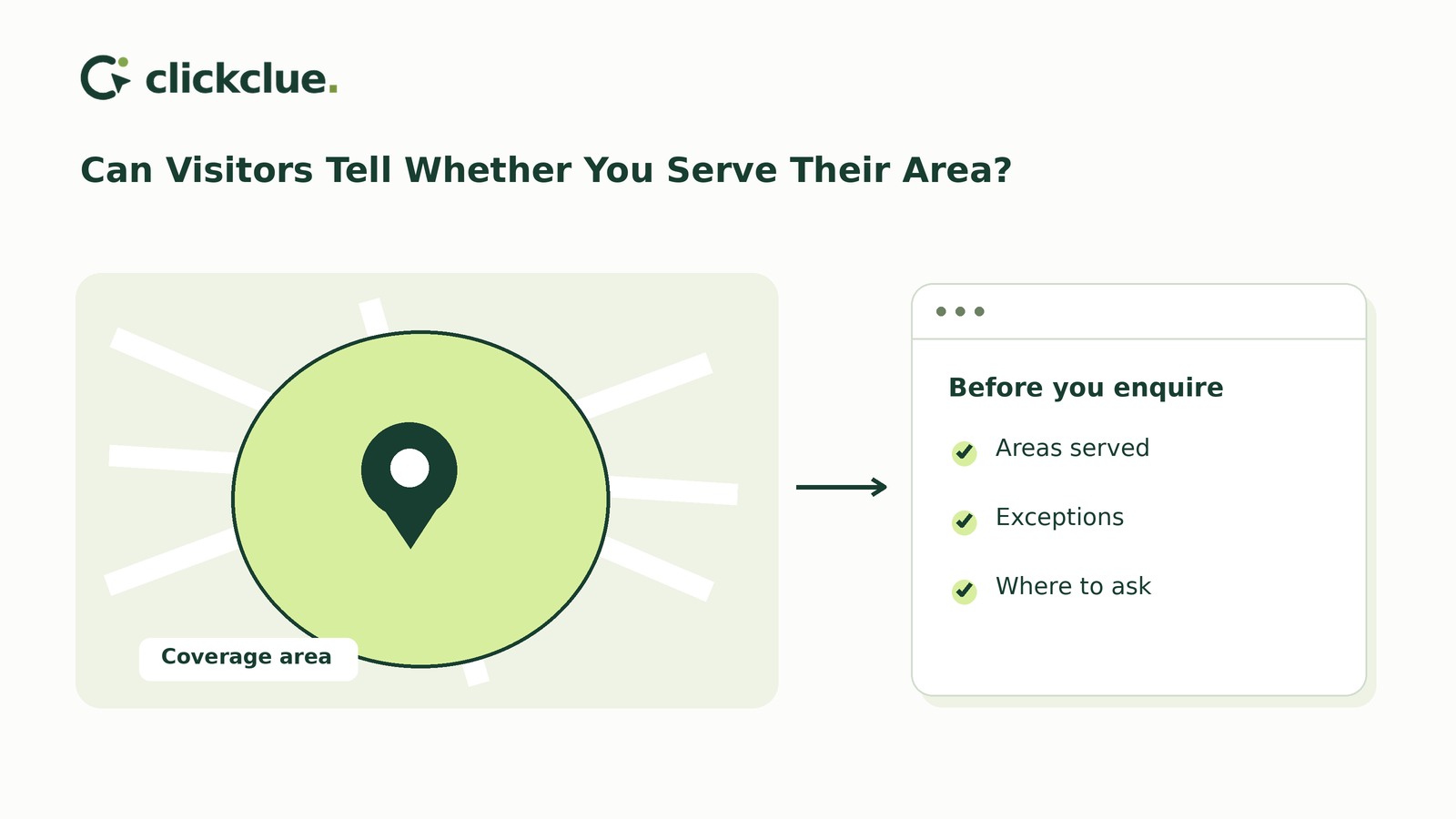
Before redesigning a service page, ask the person responsible for service delivery to confirm three cases: a location you cover, one you exclude and one that needs confirmation. If the business cannot establish the answers, clearer page design will not resolve the uncertainty.
Once those answers are verified, test whether someone unfamiliar with the page can find and interpret them. This separates an operational decision from a wording or placement problem.
Establish the coverage answers first
Choose one service page and one specific service. Routine maintenance may have different coverage from emergency call-outs.
Review the wording, map and linked coverage details with the service-delivery owner. Confirm whether named towns or districts are covered completely, what exceptions apply and who decides uncertain cases. Do not invent a service radius or treat a map boundary as authoritative without verification.
Prepare three synthetic requests using locality names, not real customer addresses:
- Clearly covered: A location and service the owner confirms are within scope.
- Clearly excluded: A location and service the business does not cover.
- Boundary case: A location requiring confirmation, with an agreed route to that decision.
Coverage does not guarantee appointment availability. Keep those decisions separate.
A case-by-case policy can be legitimate, but “ask us” needs a responsible person, enough information to decide and a working contact route. Resolve those requirements before publishing a confirmation process.
Test discovery before showing the wording
Ask someone unfamiliar with the page to try the cases from the signed-out service page. Keep your expected answers out of view.
Use a neutral task: “You need this service in this location. Use the page to decide whether the business serves you and what you would do next.”
Do not mention the coverage section, map or FAQ. Let the person navigate and say when they have an answer or would stop looking. No enquiry submission is needed.
Copy this private record for each case:
- Expected answer: Coverage decision and reason, approved next action and any contact route, approving person and approval date or reference.
- Test context: Page URL, test date, device, scenario order and prior exposure to the page.
- Unaided response: Conclusion, supporting wording or map detail, and intended next action.
- Prompted interpretation: Explanation after seeing the existing coverage wording, or a note that no answer exists.
- Help given: Any hints or explanations, and when they occurred.
- Repair and retest: Selected change, then the revised-page conclusion and next action.
Complete all unaided tasks before revealing relevant content. Then show the existing coverage wording and ask what it means for each location. Do not explain the intended answer first. If information is absent, record that gap rather than supplying an answer and counting it as success.
Identify which scenario was attempted first. Later tasks benefit from exploration and are not independent first-time discovery tests. In another session, change the starting scenario and, where possible, use a fresh participant.
Match the finding to the right repair
“Needs confirmation” can be the correct operational answer. “Cannot tell” means the reader has not resolved what the page requires. Compare both testing stages with the approved answers and next actions.
The business has no reliable answer
Ask the service-delivery owner to clarify the rule or establish a workable confirmation process. A copywriter should not fill the gap with “surrounding areas,” a guessed distance or an unsupported promise.
An approved answer is missing or contradicted
Add the verified information or reconcile conflicting wording, maps and linked details. Moving an existing paragraph will not fix an absent answer. Return disputed facts to the owner rather than choosing whichever claim seems clearest.
The answer is understood only after you reveal it
This points to a findability problem in that task. Put a short coverage summary beside or immediately before the enquiry action, with clearly labelled access to detailed rules.
The wording is found but misunderstood
Replace vague geography with verified place names or boundaries and state important exclusions. If the reader also struggled to find it, address both placement and comprehension.
The answer and next step are correctly understood
No problem was reproduced for that case. Retain useful wording rather than redesigning it merely because it looks plain. A few successful tasks do not establish universal understanding.
Worked example: change placement, not the policy
Consider a hypothetical home-cleaning business using fictional place names. Assume its manager approves regular cleaning throughout Eastmere and Brookfield, excludes Westhaven and reviews Millbridge requests individually through the existing enquiry form.
The Millbridge confirmation rule already appears in a buried FAQ. In this imagined test, an unfamiliar reader cannot find it unaided. When shown the wording, they correctly explain that they must ask for confirmation before assuming coverage.
That bounded observation supports making the clear rule easier to find, not changing the policy. Retain the detailed FAQ and add this summary near the enquiry action:
Where we offer regular home cleaning
We serve Eastmere and Brookfield. We do not serve Westhaven.
For Millbridge, use the enquiry form to ask us to confirm coverage. Tell us your locality and the service you need. Sending an enquiry does not confirm that we can serve your location.
This is example copy, not a coverage recommendation. Use only your approved rules and a contact route your team supports. If a decision needs more precise location details, obtain them through an appropriate private contact process; this page test needs no real address.
The retest criterion is specific: can a fresh reader identify the confirmation requirement and find the contact route without help? No successful retest result is assumed.
Publish consistently and retest the decision
Update the WordPress page content or ask its maintainer to change the template. Check the summary, FAQ, map and linked details against the same approved rules. Provide meaningful text rather than relying solely on map shading.
Inspect the published page signed out on a phone and desktop. Clear relevant caches if old wording remains, and confirm that the boundary contact route is reachable.
Retest with someone unfamiliar with the revision, or use fresh, owner-verified scenarios while noting prior exposure. Keep original and revised records separate. Look for the correct conclusion and next action without assistance.
These are case-specific observations, not proof of general visitor behaviour or increased enquiries. At the next review, compare the records and assign an owner to each remaining wrong answer, missing explanation or unusable next step.